
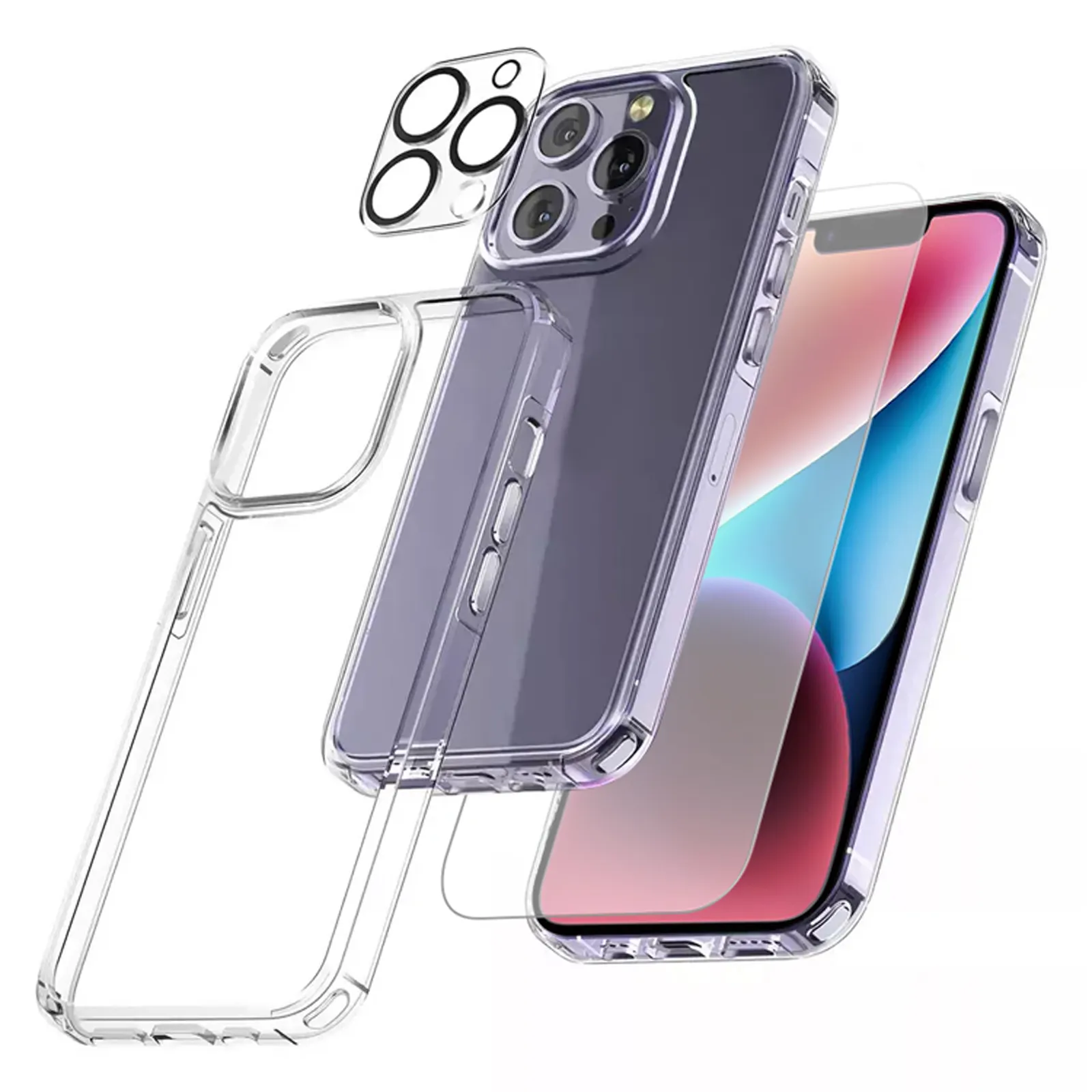
A B2B engineering and sourcing guide to 3-in-1 and multi-in-1 phone protection bundles — matching the TPU case, HD screen protector and camera lens component into one box
A phone accessory buyer in 2026 rarely wants three separate parcels arriving on three different days. The case, the screen film and the lens cover are not independent purchases — they are one protection decision made once, at the point of sale, and they are physically meant to work as a system. A 3-in-1 bundle is the recognition of that fact: a single SKU that ships a flexible TPU case, a curved tempered glass screen cover and a matching camera lens component together, with tolerances reconciled so none of the three fights the others. This article explains the engineering logic behind the bundle, the exact specification that governs a production kit, and the procurement discipline a B2B buyer needs to specify, validate and reorder it without surprises. The reference configuration quoted throughout is the iPhone-series 3-in-1 set, with the "2 & 7 in 1" option that adds a magnetic case or ships the screen protector standalone.
1. Why Protection Bundles Exist in Retail
The first thing to understand about a multi-component accessory bundle is that it is not a manufacturing trick — it is a response to three commercial forces that sit on the retail shelf long before engineering ever begins. Retailers and brand owners bundle because the economics reward it, and the end customer accepts it. Understanding those forces is the first step to sourcing the bundle well, because they determine how the kit is packaged, priced and quality-controlled.
The first force is attach rate. A screen protector sold on its own converts at a fraction of the rate of one offered inside a complete protection set at the point of phone purchase. When the case, screen cover and lens component are presented as one decision, the buyer who would have skipped the lens ring ends up with it anyway. From the brand perspective, the lens component — historically the lowest attach-rate item — rides along inside the bundle and lifts total accessory revenue per handset without a separate sales conversation.
The second force is one-box convenience. Logistics cost, packaging waste and customer confusion all fall when three products become one parcel. A single carton with a foam tray holds the case, the film and the lens component, arrives in one shipment, and is opened once. For e-commerce sellers this collapses three SKUs of storage, three picking operations and three shipping labels into one. For physical retail it collapses three peg hooks into one hero display.
The third force is margin structure. The bundle allows the supplier to price the combination above the sum of standalone parts in perceived value, while actually reducing per-unit handling cost. The case is a moulded polymer part, the screen cover is a cut and coated glass sheet, and the lens component is a small precision optic — three different manufacturing families that, combined, let a buyer present a "complete protection" story at a price the customer reads as a discount versus buying separately. The deeper manufacturing and margin logic behind selling glass and polymer accessory families together is covered in the broader OEM components guide.
None of these commercial forces change the engineering reality: a bundle is only as good as its weakest part, and the weakest part is usually the one whose tolerance was never reconciled with the others. The rest of this article is about making sure that does not happen.
2. What the Multi-Part Set Contains
A standard 3-in-1 configuration contains exactly three functional components, and the "2 & 7 in 1" naming used in the product specification describes how those three are offered. "2 in 1" refers to the screen protector paired with the camera lens component, the two flat optical parts that are most often sold together. "7 in 1" refers to the full set that adds a magnetic phone case plus a spread of installation accessories — wipes, dust stickers, an alignment frame and sometimes a spare film. The standalone screen protector option exists for buyers who only want the glass and already have a case.
The three core parts are worth defining precisely, because their failure modes are completely different:
| Component | Primary Job | Key Failure Mode |
|---|---|---|
| Flexible TPU case | Absorb impact, hold the device, provide the raised edges that protect screen and camera | Poor cut-out alignment, yellowing, loose fit, edge interfering with the screen cover |
| HD screen protector | Defend the display from scratch and impact while preserving clarity and touch | Lifting at edges, bubbles, halo at curved zones, coating wear |
| Camera lens component | Shield the rear optics from scratch and shatter without harming imaging | Flare, ghosting, misalignment over the aperture, adhesive in the light path |
| Magnetic case (optional) | Adds MagSafe-style accessory compatibility to the protective case | Magnet misalignment, added thickness, interference with wireless charging |
The reference kit is specified for the iPhone 6/7/8/X/XS/XR/11/12/13/14/15 series, including the Pro, Pro Max, Plus and Mini variants. That is a very wide model spread, and it is the single biggest sourcing challenge: a bundle that claims ten generations of iPhone coverage is actually a matrix of ten-plus moulded cases, a matching matrix of cut glass, and a matching matrix of lens components, all sharing one box design and one quality spec. The product page for the combined TPU case with screen and lens protector shows the full model coverage, while the standalone tempered glass screen protector set covers the optical parts on their own.
3. Reconciling Component Tolerances
The defining engineering problem of any bundle is that three separately manufactured parts must agree on the same device envelope. A case is moulded polymer with mould shrinkage and parting-line variation. A screen cover is cut glass held to tenths of a millimetre. A lens component is a small precision optic. Each is built to its own tolerance budget, and unless those budgets are deliberately reconciled, the parts interfere with each other in ways the customer sees immediately.
Three interference modes dominate. The first is the raised-edge conflict. A protective case correctly has a lip that stands slightly proud of the screen so that, when the phone is dropped face-down, the glass never touches the ground. But that same lip, if too tall or too thick, can lever the edge of the screen protector up, creating a lift line and a dust-entry point along the perimeter. The case lip height and the screen cover edge profile must be designed together, not independently.
The second is the lens-ring conflict. The case usually has a cut-out or a raised collar around the camera module. If that collar is too tight, it overlaps the lens component and blocks part of the field of view or catches light. If it is too loose, the lens component sits proud and can snag. The lens component diameter and the case cut-out must be matched to the same module drawing.
The third is the curvature conflict. A 3D/5D/6D/9D full curved cover wraps the edges of the display. A case designed for a flat film will pinch that curved edge and cause peeling. The case inner profile has to anticipate the screen cover's curve radius.
Target a lip that clears the cover by a defined gap so it protects on impact but never contacts the film in normal use. Specified as a single shared dimension on the bundle drawing, not two separate ones.
The case aperture and the lens component outline are both referenced to the module drawing. The clearance is held symmetric so the ring seats flush and the collar frames it without overlap.
The full curved cover's edge radius is fixed by the glass spec; the case inner wall is moulded to clear it. Mismatched radius is the usual cause of perimeter bubbling.
The practical rule for a buyer is simple: never qualify the three parts separately and assume they fit. Qualify the assembly. The lens-fit discipline described for standalone optics in the camera lens protector engineering guide applies identically inside the bundle, except the reference drawing now includes the case.
4. The Screen Cover's Engineering Role
Inside the bundle the screen protector is the largest and most visible optical part, and it carries the most demanding specification of the three. The reference kit specifies Japanese AGC glass with AB glue, 9H hardness, and a 3D/5D/6D/9D full curved cover. Each of those terms is an engineering choice, not a marketing label, and a buyer should know what each one commits the supplier to.
AGC glass is a named Japanese soda-lime float substrate. Naming the substrate matters because the alternative — an unnamed or sub-grade glass — is where hardness and clarity claims quietly break down. AB glue refers to the optically clear adhesive system used to bond the glass to the display: it is the layer that determines bubble-free installation and edge adhesion. 9H is the pencil-hardness grade of the surface coating, the standard claim for tempered optical parts and the figure most often tested and faked in the market.
The 3D/5D/6D/9D nomenclature describes how far the cover wraps the display edges. A flat 2D cover protects only the planar face. A 2.5D cover adds a polished edge. The higher numbers indicate progressively fuller edge coverage that follows the curved glass of modern displays. For the iPhone series in the bundle, full curved coverage is what prevents the halo and lift line that a flat film leaves at the bezel.
| Specification | Engineering Meaning | Why It Matters in a Bundle |
|---|---|---|
| Japanese AGC glass | Named float substrate with consistent thickness and clarity | Removes substrate guesswork; pairs with case curvature |
| AB glue | Optically clear adhesive for full-area or edge bonding | Drives bubble-free install and perimeter hold |
| 9H hardness | Pencil-hardness grade of the surface coating | Scratch resistance claim; must be batch-verified |
| 3D/5D/6D/9D curved | Edge coverage radius following the display curve | Prevents halo and lift where the case lip meets the film |
| Full glue / bubble-free | Adhesive covers the full area, not just the edges | Touch feel and the "smooth flexible touch" claim |
The "smooth flexible touch" claim is a direct consequence of the adhesive and edge design: a full-glue curved cover transmits touch through the same glass plane as the display, so the finger does not feel a step at the edge. The alternative — an edge-only bonded film — can leave a soft or dead zone at the perimeter. The broader buyer questions around hardness grades and edge types are treated in the 9H screen protector explainer and the curved cover benefits article.
5. Camera Optics and Imaging Safety
The lens component inside the bundle is the smallest part and the easiest to damage the phone with if done wrong. A screen cover that fits badly looks like a defect; a lens component that fits badly degrades every photograph the customer takes. The bundle therefore inherits all the optical discipline of a standalone lens protector, and the buyer should hold it to the same standard.
The lens component's job is to sit over the rear camera apertures and absorb scratch and impact energy before it reaches the module's own cover glass, while passing the maximum usable light through to the sensor. The conflict is built in: protection wants thickness and hardness, transmission wants an ultra-thin clear surface, and fit wants tight dimensional control. A bundle lens component is the negotiated outcome of those three demands, and the negotiation is conducted in the coating stack and the aperture tolerance.
Two risks are specific to the bundle context. The first is that the case's camera collar, discussed in section 3, can overlap or shadow the lens component and introduce a halo or vignetting in bright light. The second is that the lens component, being a small part, is the easiest to misalign during the customer's own installation, and a kit with no alignment aid will generate support tickets. Both are design problems the supplier owns, not user error.
The optical material and coating logic is identical to standalone parts: the substrate should be optical or tempered glass, the surface should carry an anti-reflection stack and an oleophobic layer, and the aperture must be positioned to the module drawing. The manufacturing and material choices are detailed in the lens protector manufacturing guide and the comparison of glass versus sapphire lens covers, while selection criteria are in the camera lens protector selection guide.
6. TPU Case Engineering
The TPU case is the structural backbone of the bundle. Thermoplastic polyurethane is chosen over rigid PC or polypropylene because it is flexible enough to snap over a phone without cracking, yet tough enough to absorb and spread impact energy. That flexibility is exactly what lets the case provide the raised screen and camera lips without the brittleness of a hard shell.
Four case features decide whether the bundle protects or merely decorates. Corner airbags are thickened, often hollow or energy-dispersing zones at the four corners, where the majority of drop impacts concentrate. Precise cut-outs keep the speakers, ports and buttons accessible without compromising the seal. The raised lip we have already discussed protects the screen cover on face-down drops. And the camera collar frames the lens component.
Energy-absorbing zones at the impact-prone corners. Their volume and wall thickness are tuned so the case deforms and recovers rather than transmitting shock to the frame.
Moulded openings held to the device tolerance so buttons stay clickable and ports stay clear. Sloppy cut-outs are the most common cause of returns on bundled cases.
Screen and camera lips that stand proud of the glass. Their height is the shared dimension reconciled with the screen cover and lens component, never designed in isolation.
TPU has one well-known weakness that the bundle spec must address: yellowing. Untreated clear TPU oxidises under UV and heat and turns amber within months, which looks terrible against a coloured phone and signals cheap material. A serious bundle either specifies UV-stabilised TPU or commits to a matte or tinted finish where yellowing is invisible. The case is also where the optional magnetic array lives in the "7 in 1" variant, and magnet placement must be held concentric with the device's own charging coil to avoid charging loss — a discipline shared with the magnetic cover design article.
7. Interpreting the Drop Test
The bundle specification includes a precise and unusual statement: "64g Steel Ball Fell 3 Times Without Breaking (Hanging Glass)". This is worth unpacking, because it is a real test method and it tells the buyer exactly what was validated and what was not.
A 64-gram steel ball is a standard impact mass in glass testing. The figure "fell 3 times" means the same sample was subjected to three separate impact drops of the ball, not one. "Without breaking" means the glass did not crack or shatter through those three impacts. "Hanging glass" describes the test geometry: the glass sample is suspended or hung, rather than laid on a backing anvil, so the impact energy is absorbed by the glass and its bond rather than being cushioned by a support beneath it. A freely hanging sample is a harsher condition than a glass resting on a soft pad, because there is no support to share the load.
What this tells a buyer is that the screen cover was validated for a defined, repeatable impact — a 64g ball, three drops, unsupported. It is not a guarantee against every real-world fall, because a phone dropped onto a corner transmits far more complex load than a hanging glass struck by a ball. But it is a meaningful, repeatable pass criterion, and it is the kind of specific claim a buyer should prefer over vague "military grade drop protection" language that names no mass, no count and no geometry.
| Test Element | What It Means | Buyer Takeaway |
|---|---|---|
| 64g steel ball | Defined impact mass, reproducible between labs | Ask for the drop height; mass alone is not the full condition |
| 3 times | Three impacts on the same sample, not a single hit | Shows repeatability, not a lucky first strike |
| Without breaking | No through-crack or shatter across the three drops | The glass is the sacrificial layer; surviving intact is the pass |
| Hanging glass | Unsupported sample, no backing to share load | A harsher condition than glass laid on a pad; strengthens the claim |
A buyer should request the missing variable — the drop height — and the test report, then reconcile it with the case drop performance, because in the bundle the glass is supported by the case lip on a real fall. The relationship between component-level impact tests and full-device protection is the same logic applied to back covers in the back cover versus screen protector comparison.
8. Oleophobic Coating and Water Angle
The bundle specification carries a precise coating requirement: "Water Droplet Angle: Before Rubbing >115°±2, After 3000 Rubs ≤105°±2". This is a direct, measurable statement about the oleophobic (oil-repelling) layer on the screen cover, and it is one of the most useful specifications a buyer can hold a supplier to, because it degrades in service and is easy to test.
A water droplet angle, or contact angle, measures how round a water drop sits on the surface. A high angle — above 115 degrees here, with a tight ±2 degree band — means the surface is highly hydrophobic and oleophobic: water beads up and rolls off, and fingerprint oil does not spread into a smear. A low angle means the surface wets easily and oils stick. The "before rubbing" figure is the new-product state; the "after 3000 rubs" figure is the worn state, and the supplier commits that even after 3000 abrasion cycles the angle stays above 105 degrees.
Why this matters is twofold. On the screen cover, a healthy oleophobic layer keeps the display readable, makes fingerprints easy to wipe, and prevents the smeared-oil flare that can hurt contrast in bright light. On the lens component, the same layer stops skin oils from fogging the rear camera between cleaning. When the coating wears off, the part looks dirty constantly and the customer blames the product, not the chemistry.
The ±2 degree band is the disciplined part of the spec. A claim of "greater than 110 degrees" with no band is meaningless, because measurement varies by a degree or two between instruments. Pinning it to ±2 means the supplier expects consistent, in-control coating, not a lucky golden sample. A buyer should request the per-batch contact-angle report and re-test on incoming inspection after 3000 rubs using a standard eraser or wool cycle. The anti-reflection and coating technology that sits beneath the oleophobic top layer is explained in the AR coating technology guide.
9. Bundle Yield and Scrap Logic
The hardest financial fact about a bundle is that its yield is not the average of its parts — it is the product of their yields. If the case passes at 98 percent, the screen cover at 97 percent and the lens component at 96 percent, the probability that all three in one box are good is 0.98 × 0.97 × 0.96, or about 91 percent. Roughly nine boxes in a hundred contain at least one non-conforming part, and one bad part scrap-ates the entire bundle even if the other two are perfect.
This is why a bundle demands tighter per-part quality than a standalone item. A standalone screen cover at 97 percent yield is a perfectly normal consumer-electronics number. The same 97 percent inside a three-part bundle becomes a 9 percent scrap-and-rework exposure. The only levers are raising each part's yield, inspecting at the kit level rather than the part level, and designing the packing so a defective part is caught before it is boxed.
The lens component is usually the yield-limiting part, because it is the smallest and carries the tightest optical tolerance. A cosmetic speck that would pass on a large screen cover can fail a lens component graded against a limit sample. Smart bundlers therefore over-build the lens component yield or sort it more strictly than the case, because a scrapped case is cheap but a scrapped kit is three scrapped parts.
| Part Yield | Bundle Yield (3 parts) | Scrap Exposure |
|---|---|---|
| 99% / 99% / 99% | 97.0% | 3.0% of kits carry a defect |
| 98% / 97% / 96% | 91.3% | 8.7% of kits carry a defect |
| 95% / 95% / 95% | 85.7% | 14.3% of kits carry a defect |
The procurement conclusion is direct: when negotiating a bundle, do not accept a part-level AQL applied independently to each component and assume the kit is fine. Specify a kit-level acceptance criterion and ask how the supplier counts a kit failure. The same AQL thinking used for glass covers in the reliable manufacturer guide applies, but the sampling plan must be written for the assembled box.
10. Packaging and Retail Design
Packaging is where the bundle either feels premium or feels like a bag of loose parts. A good 3-in-1 box does four jobs: it protects the three components in transit, it presents them as one coherent product, it carries the installation tools, and it teaches the customer how to fit the parts in the right order. The sibling product lines give a useful size reference — a single-package footprint around 18.5 × 10 × 1.2 cm is representative for this category of combined kit.
The internal structure matters more than the outer print. A moulded foam tray or vacuum-formed insert holds the case, the screen cover (still on its backing card) and the lens component in fixed pockets so they cannot rub each other in transit. The screen cover especially must never be allowed to slide against the case, because TPU can transfer plasticiser or pick up abrasion marks onto the glass. A separate, sealed sachet holds the wet wipe, dry wipe, dust-removal sticker and alignment frame.
Installation order should be printed or illustrated on the inside of the lid: clean the phone, fit the case, then apply the screen cover using the alignment frame, then seat the lens component. Getting the order wrong — fitting the case after the screen cover, for instance — is a common cause of edge lift. The instructions should specify that the customer aligns the lens component to the module before peeling the full adhesive, since once a small optic is stuck it is hard to reposition.
Retail design also includes the variant labelling. Because the same kit ships as "2 & 7 in 1" and as a standalone screen protector, the box must make clear which variant is inside, and the barcode must differentiate them, or warehouse picks will mix them. The full component range and bundle variants are listed in the product center, which is the master reference for what each SKU contains.
11. Bundle Economics Versus Single Items
The economic case for bundling is real but easy to miscalculate. On paper, selling three items as one appears to sacrifice the margin of three separate sales. In practice, the bundle usually wins on three lines that standalone sales lose: it raises the attach rate of the low-conversion items, it cuts the per-order fulfilment cost, and it lifts the average order value at the point of decision.
The first gain is attach rate. As noted in section 1, the lens component is the hardest single item to sell. Inside the bundle it is no longer a separate decision. The brand captures lens-component revenue it would otherwise never have earned, and the effective margin on that captured revenue is higher than zero.
The second gain is fulfilment. Three SKUs picked, packed and shipped separately cost three handling events and three parcels. One bundle costs one. For a high-volume seller the labour and material saving on cartons, tape and labels alone can exceed the margin given away on the "bundle discount" perception.
The third gain is perceived value. A customer comparing a bare case at full price against a complete protection set at a small premium almost always reads the set as the better deal, even when the set's effective unit cost to the seller is lower. The discount is psychological, funded by the fulfilment saving and the captured attach rate, not by cutting part quality.
The risk in the economics is the yield penalty from section 9. If scrap exposure climbs because the bundle is assembled from loosely controlled parts, the fulfilment saving is eaten by rework and returns. The bundle only pays if the per-part quality is held tight enough that kit yield stays high. That is the central tension of bundle sourcing, and it is why the QC section that follows is not optional reading.
12. OEM and ODM Customization
For a B2B buyer the bundle is rarely bought as a finished, fixed product — it is usually specified. The reference kit already supports the customization axes a brand needs: model coverage across the iPhone 6 through 15 families, colour options on the case and lens component, LOGO placement, and brand-level packaging. The distinction between OEM (build to the buyer's existing design) and ODM (co-develop the design with the supplier) matters for who owns the tooling and the validation.
Size customization is the largest effort: each iPhone generation has a different camera module layout, screen curve and button positions, so the case mould, the screen cover cut file and the lens component aperture map must all be regenerated per model. A supplier that already carries the drawing library for the 6-through-15 series can tool a new variant faster than one starting from a blank. Colour customization runs from clear and matte TPU through tints and printed patterns, and the lens component colour or LOGO is locked against a master chip.
Case mould, screen cut file and lens aperture map per device. The kit already spans iPhone 6/7/8/X/XS/XR/11/12/13/14/15 including Pro, Pro Max, Plus and Mini.
Clear, matte, tinted or printed TPU; lens component colour or LOGO locked to a master sample. Brand differentiation without changing the tooling.
Private-label box, insert and instruction print. The variant (2 & 7 in 1 or standalone) must be barcode-differentiated to avoid warehouse mix-ups.
The customization conversation should happen on the bundle drawing, not on the three parts separately, because the value of customization is often in how the parts present together — matched case and lens colours, a LOGO placed where it survives the curved screen cover, a box that names the exact variant. The wider OEM component and private-label logic is in the custom cover plate guide and the China-sourcing procurement overview in the B2B procurement guide.
13. QC and AQL for Assembled Kits
Quality control for a bundle has two layers: part-level incoming inspection and kit-level final inspection. Both should be written into the purchase contract, and the kit-level plan is the one most buyers forget. AQL — Acceptable Quality Limit — sampling under ANSI/ASQ Z1.4 or ISO 2859-1 is the standard framework, but the defect classes must be assigned at the kit level.
A critical defect is anything that makes the kit unusable or unsafe: a screen cover with a crack, a lens component with adhesive in the aperture, a case with a missing corner. A major defect is something the customer will notice and may return: a visible scratch on the glass, a misaligned camera cut-out, a yellowed case, an oleophobic angle below spec after rubbing. A minor defect is cosmetic only and within the agreed limit sample: a faint mould mark on the case interior, a tiny edge nick hidden under the lip.
| Inspection Area | Kit-Level Criterion | Method |
|---|---|---|
| Screen cover | No crack, no bubble after install, contact angle per spec | Visual, contact-angle gauge, install trial |
| Lens component | Aperture clear, no adhesive in light path, aligned to module | Vision system, fit check on device |
| Case | Cut-outs correct, lips matched to glass, no yellowing | Fit on reference device, visual grading |
| Packaging | Correct variant labelled, tools present, tray intact | Open-and-verify sampling |
| AQL | Separate levels for critical / major / minor, kit-level | ANSI/ASQ Z1.4 or ISO 2859-1 |
The limit sample is the single most useful document in bundle QC. It is a set of approved physical examples defining the worst cosmetic condition acceptable, agreed before mass production. With it, "is this scratch acceptable" becomes a measured comparison instead of an argument. Buyers sourcing from China should also read the supplier selection guide for the questions to ask about in-house inspection capability.
14. B2B Sourcing Checklist
| 1 | Fix the model matrix first — confirm which iPhone generations the bundle must cover and get the case mould, screen cut file and lens aperture map listed per model. |
| 2 | Name the substrate and adhesive: Japanese AGC glass, AB glue, full-glue curved cover. Put the material names on the drawing, not just "tempered glass". |
| 3 | Require the measurable coating spec: water droplet angle >115°±2 new and ≥105°±2 after 3000 rubs, with a per-batch report. |
| 4 | Reconcile the shared tolerances: case lip height vs screen edge, camera cut-out vs lens ring, curve radius vs case inner wall — one bundle drawing. |
| 5 | Get the drop test detail: 64g steel ball, three drops, hanging glass, plus the drop height and the test report. |
| 6 | Write a kit-level AQL with separate critical, major and minor levels, and agree a cosmetic limit sample before production. |
| 7 | Confirm the packaging: foam tray, install tools, instruction with correct fit order, and barcode-differentiated variants. |
| 8 | Lock customization: case colour, lens colour or LOGO against a master chip, and private-label box print. |
| 9 | Run a first-article assembly check, not three separate part approvals — verify the parts fit together on a real device. |
| 10 | Plan for yield: ask how a kit failure is counted and what the supplier's kit-level scrap rate is, because it drives true landed cost. |
Following this checklist converts the bundle from a box of three loosely related parts into a specified system with a known failure mode and a known cost. The same diligence applied to standalone glass is documented in the screen protector buyer guide and the 9H comparison article.
15. Frequently Asked Questions
Does the lens component in the bundle hurt camera image quality?
Not if it is engineered like the standalone part. With an anti-reflection stack and a correctly positioned aperture, the transmission penalty is smaller than the variation between devices. The risk in a bundle is the case collar overlapping the lens ring; that is a fit problem, solved by reconciling the camera cut-out and the lens component on one drawing, not a reason to skip the lens protection.
Why specify a water droplet angle instead of just saying "oleophobic"?
"Oleophobic" is a claim; a contact angle is a measurement. The spec >115°±2 new and ≥105°±2 after 3000 rubs tells the supplier the coating must survive real abrasion, not just look good on day one. It is the difference between a coating that lasts months and one that smears within weeks, and it is cheap to verify on incoming inspection.
What does "64g steel ball fell 3 times without breaking" actually prove?
It proves the screen cover survived three defined impacts of a 64-gram ball on an unsupported (hanging) sample without cracking. It is a repeatable, lab-comparable pass criterion. It is not a promise against every real-world drop, so pair it with the case's corner-airbag performance and ask for the drop height to complete the picture.
Should I buy the bundle or the three parts separately?
For resale and gifting, the bundle wins on attach rate, fulfilment cost and perceived value. For service centres and DIY customers who only need a screen cover, the standalone protector option exists for exactly that. The decision is commercial, not technical — both share the same AGC glass and coating spec.
Can the bundle be customized with our brand and colours?
Yes. Case colour, lens component colour or LOGO, and private-label packaging are standard OEM/ODM options. The key is to specify on the bundle drawing and lock colours against a master sample, because matched case-and-lens colour and LOGO placement that survives the curved screen cover are where customization either looks intentional or looks cheap.
Specifying a 3-in-1 Protection Bundle?
Send us your model matrix and tolerance requirements. We build TPU case, HD curved screen protector and camera lens component bundles as OEM/ODM, with Japanese AGC glass, AB glue, 9H hardness and a measured oleophobic coating spec across the iPhone 6 through 15 series.